


A Compare and Contrast of the Crosstrek and Forester
The Subaru Crosstrek and Forester may appear very different, but they actually share quite a bit in common. If you are wondering which is best for you, this Ewing Subaru of Plano blog aims to help.
The Crosstrek and Forester are Subaru’s most affordable crossovers, with the Crosstrek being the less expensive of the two. They share many features and have some notable differences.
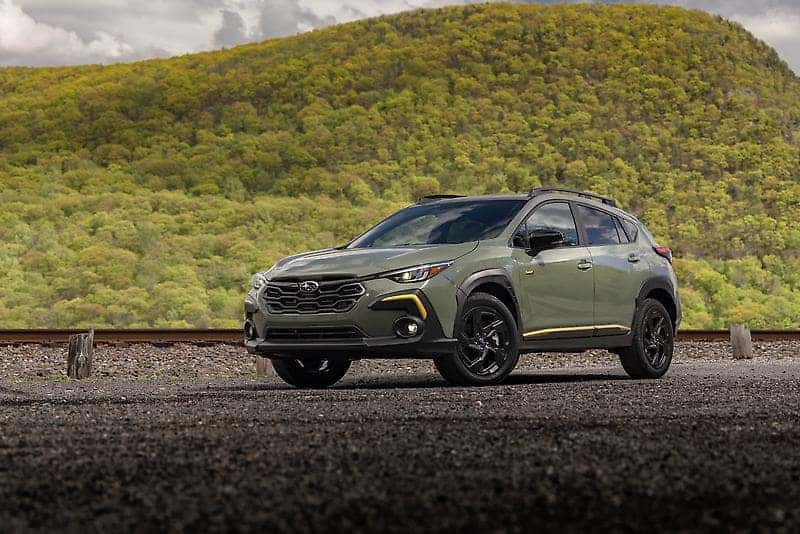
What They Have in Common
Both models share the same drivetrains. For most trims on either model line, this is the 2.5-liter boxer-4 engine that produces 180 horsepower at 5,800 rpm and 178 lb-ft of torque at 3,700 rpm. In both cases, the engine is paired with a continuously variable transmission (CVT), which then sends power to all four wheels via the standard Subaru Symmetrical all-wheel-drive system. This also results in the same EPA-estimated city/highway/combined fuel economy of 26/33/29 for both models, and both have the same 16.6-gallon fuel tank.
For 2026, both models are also available with hybrid drivetrains. Using a version of the 2.5-liter engine combined with an electric motor, both hybrid models deliver 194 horsepower with the system paired to a CVT with six preset ratios for manual shifting. With the hybrid system, the Crosstrek is slightly more efficient, with an EPA estimate of 36/36/36, compared to 35/34/35 for the Forester. In non-wilderness form, both models have the same maximum towing capacity of 1,500 pounds.
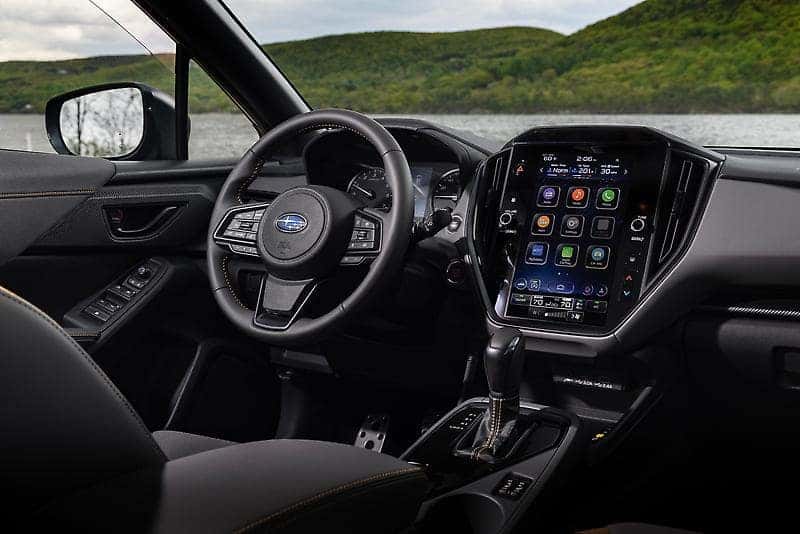
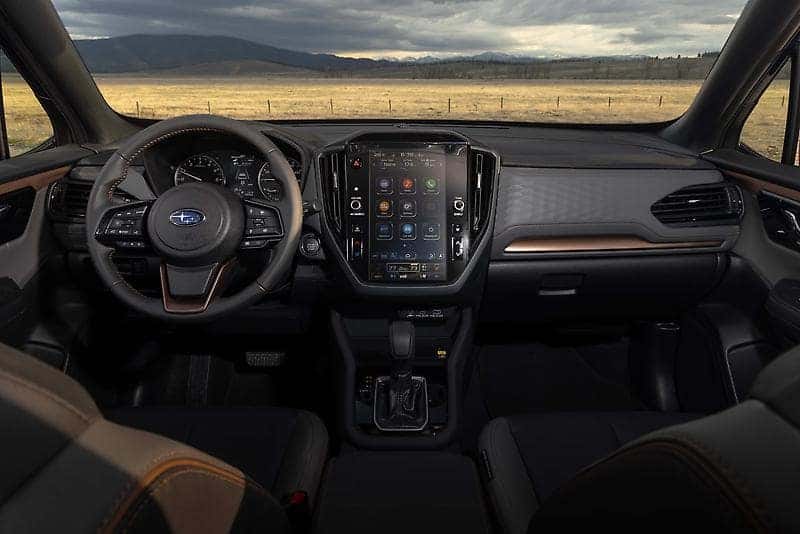
Both models are five-seaters and share a 103-inch wheelbase as well as an 8.7-inch ground clearance, with Wilderness models offering 9.3 inches. Inside, both feature not identical but similar dashboards with analog gauges, a tri-spoke steering wheel, and an 11.6-inch center touchscreen with the same capabilities, including wireless smartphone compatibility.
Differences in Size and Shape
Almost all differences between the two models come down to size and proportions. The Forester is considered a compact crossover, competing against models like the Toyota RAV4 and Honda CR-V. Interestingly, the Crosstrek is clearly based on the Impreza hatchback, which is classified as a compact vehicle; however, the Crosstrek itself is categorized as a subcompact, making it slightly larger than other subcompact crossovers, such as the Toyota Corolla Cross and Honda HR-V.
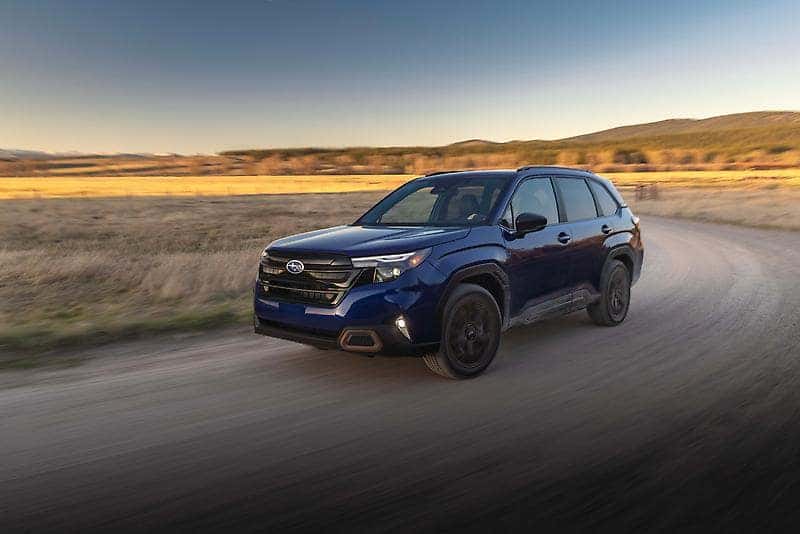
Despite sharing a wheelbase, the Forester is seven inches longer (183 inches vs. 176 inches), two inches wider (81 inches vs. 79 inches), and six inches taller (68 inches vs. 62 inches). This results in slightly more legroom in the front row and just a hair under three additional inches of rear legroom, along with about 1.5 extra inches of headroom for both seating rows. The increased length and a more squared-off rear roof treatment contribute to nearly ten more cubic feet of cargo space behind the rear seats (26.6 vs. 19.9), with the difference almost doubling when the seats are folded down (74.4 vs. 54.7 cubic feet).
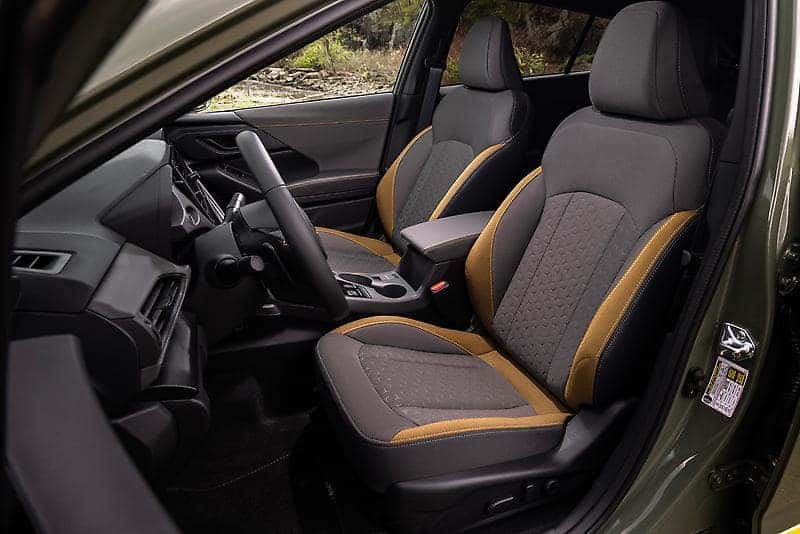
The counterpoint is that the larger body adds more weight. For example, the base Crosstrek weighs 3,296 pounds, compared to 3,510 for the base Forester. While this isn’t reflected in fuel economy, it does make the Crosstrek slightly quicker with a non-hybrid 0-60 mph time of 8.1 seconds versus 8.3 seconds for the Forester, and the lower weight and height make the Crosstrek easier to toss into a curve.
Price and Available Amenities
There are two other main differences between the models, with the most significant being affordability. The base Crosstrek starts at a Manufacturer’s Suggested Retail Price (MSRP) of $26,995 compared to $29,995 for the base Forester, and that $3,000 gap widens as you move up the trim levels, reaching the Wilderness models where the Forester is priced at $38,385, $4,590 more than the Crosstrek Wilderness at $33,795. Upgraded features are more abundant on the Forester, including ventilated front seats, leather seating surfaces, and driver position memory, which are not available on the Crosstrek. The Harman Kardon premium audio system is offered on both vehicles, but is available on more Forester trims.
If you need space, the Forester is the logical choice, especially if you want some of the Forester-only features listed above. However, if the Crosstrek meets your needs, you’ll benefit from a lower initial cost, improved performance, and, in the case of hybrid models, slightly better fuel economy.
Of course, one of the best ways to find out which model suits you best is to visit Ewing Subaru of Plano and sample them both. With its extensive inventory, you are sure to find the model that works best for you.
0 comment(s) so far on A Compare and Contrast of the Crosstrek and Forester